Correctional Officer Jobs in Canada: Ontario and Federal Requirements, Training and Pay (2026)
Correctional officer jobs offer stable, unionized, well-paid public sector careers, but the hiring process is long and demanding. Here is how the Ontario and federal processes work, the fitness test and training, what correctional officers earn, and how to prepare.
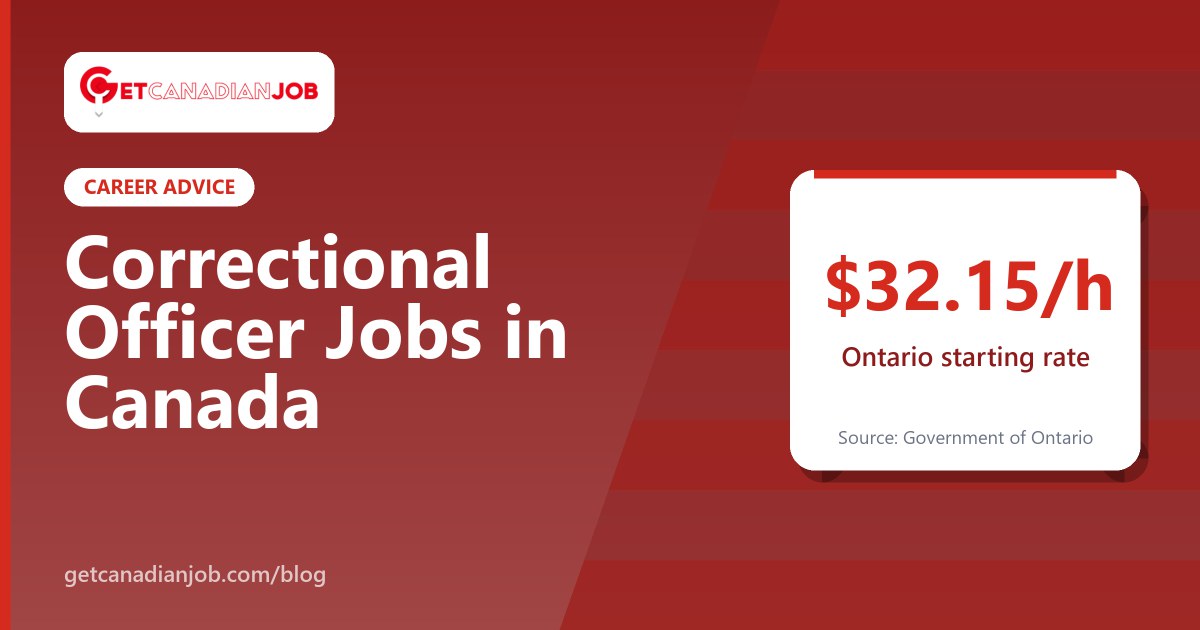
Table of contents
Last reviewed: October 26, 2026
Short answer: in Canada, you can work as a correctional officer for a province, in jails and remand centres for sentences under two years, or for Correctional Service Canada (CSC), in federal penitentiaries for sentences of two years or more. In Ontario you need Grade 12, first aid and CPR, and you must pass written tests, an interview, the FITCO fitness test, security screening and an eight-week training program. Ontario's starting rate is $32.15 an hour. Job Bank puts the national median for correctional service officers at $36.15 an hour, about $70,000 a year.
Key takeaways
- Ontario correctional officers start at $32.15 an hour (Government of Ontario).
- The Ontario process can take up to six months, and a final decision up to 12 months.
- Ontario training is an eight-week program called Corrections Foundational Training (CFT-CO), with a training stipend.
- Job Bank's median for correctional service officers is $39.00 an hour in Ontario and $36.15 nationally.
- You can only apply to advertised postings. Ontario does not accept direct applications.
What does a correctional officer do?
Correctional officers supervise people held in custody and keep the institution safe for everyone inside it. The job includes:
- supervising inmates in living units, yards, kitchens and programs;
- doing counts, searches of people and cells, and escorts to court or hospital;
- de-escalating conflicts and responding to emergencies, including medical ones;
- writing incident reports and keeping accurate records;
- supporting rehabilitation by working with program staff, health care and probation officers.
It's shift work in a demanding setting. The pay, the benefits and the defined benefit pension are a big part of why the jobs are popular, and "correctional officer jobs" gets more impressions than almost any other search on GetCanadianJob.
What is a typical shift like?
Most correctional centres run around the clock, so officers work rotating day, afternoon and night shifts, including weekends and holidays. A shift usually starts with a briefing and a count, then moves through meals, programs, visits, court escorts, cell searches and paperwork. Much of the job is communication: listening, explaining rules, spotting tension early and calming situations before they escalate. Some days are routine and others involve emergencies, so employers look for people who stay steady, follow procedures and work well as part of a team.
Provincial or federal: which one is right for you?
| Provincial (for example, Ontario) | Federal (Correctional Service Canada) | |
|---|---|---|
| Who's held there | People on remand and sentences under two years | Sentences of two years or more |
| Where you apply | The province's public service careers site | GC Jobs (Government of Canada) |
| Training | Ontario: 8-week CFT-CO program, with a stipend | Correctional Training Program, including an in-person stage at CSC's training academy |
| Job title | Correctional Officer | Correctional Officer I (CX-01) |
| Example pay | Ontario: from $32.15 an hour | A 2025 CX-01 posting listed $66,974 to $84,045 a year |
How to become a correctional officer in Ontario
The Government of Ontario lists these requirements:
- at least 18 years old;
- an Ontario Secondary School Graduation Diploma or an approved equivalent;
- emergency first aid, CPR and AED certification, current or obtained by your first day;
- able to work rotating shifts, including nights, weekends and holidays;
- for bilingual positions, oral French at the advanced-minus level.
The hiring process runs in this order:
- Apply to an advertised posting on the Ontario Public Service careers site, with every mandatory document. Incomplete applications aren't considered.
- Written tests: aptitude, cognitive and psychological tests set by the ministry.
- Interview.
- FITCO (Fitness Test for Ontario Correctional Officer Applicants), booked with a participating college. It costs at least $79 a try and includes a search station, an emergency response circuit and a shuttle run. You'll repeat it during training.
- Security screening, including a Vulnerable Sector Check. If you lived outside Canada in the past five years, you'll also need a police clearance letter from that country.
- Conditional offer and medical exam, paid for by you.
- CFT-CO training: eight weeks of training and assessment, with a training stipend.
How much do correctional officers make in Canada?
Job Bank's 2025 wages for correctional service officers (NOC 43201):
| Area | Median hourly wage | About per year (full-time) |
|---|---|---|
| Canada | $36.15 | $70,000 |
| Ontario | $39.00 | $76,000 |
| Toronto | $39.54 | $77,000 |
| Calgary | $38.28 | $75,000 |
| Edmonton | $37.50 | $73,000 |
| British Columbia | $36.00 | $70,000 |
On top of base pay, there are shift premiums, overtime, and a public service pension and benefits. Pay rises with each step of the collective agreement.
Related jobs: probation and parole officers
If you'd rather work with people in the community, look at probation and parole officer jobs. They usually need a university degree in social work, criminology or a related field, and Job Bank puts the national median at $40.35 an hour. Many correctional officers move into these roles, or into program officer, intelligence or management jobs, after a few years.
How to prepare and stand out
- Start training for the FITCO early. Ontario offers free practice sessions at its correctional training centre in Hamilton.
- Get first aid, CPR and AED before you apply.
- Show calm, fair judgment on your resume and at the interview. Security, youth work, mental health support, the military and customer-facing jobs all count. See our Canadian resume format guide.
- Keep your record clean and gather any foreign police clearances now, because they can take months.
- Apply to several postings. Ontario hires for specific institutions, so list every location you would genuinely accept.
Browse current openings in public sector jobs in Canada and security and enforcement jobs, then create a free GetCanadianJob account to get new correctional jobs by email.
Sources
- Government of Ontario, "Become a correctional officer" (requirements, FITCO, CFT-CO, starting rate)
- Job Bank (Government of Canada), wages for correctional service officers (NOC 43201) and probation and parole officers (NOC 41311), 2025 release
- Correctional Service Canada, Correctional Officer I (CX-01) job postings, 2025
- Correctional Service Canada, evaluation of the Correctional Officer Recruitment Allowance