How Will AI Affect Jobs in Canada? What the 2026 Data Shows
Four in ten Canadian workers now use AI on the job, and about 30% work in occupations where AI could replace a big share of their tasks. Here is what the latest Statistics Canada data says about AI and jobs in Canada, and how to protect your career.
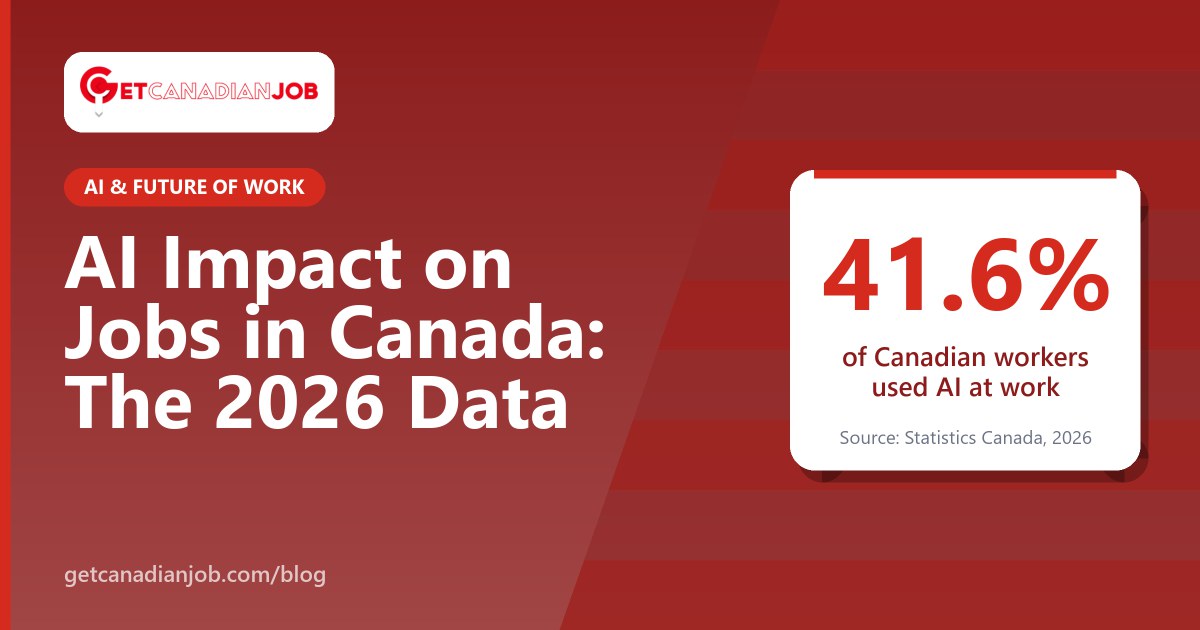
Table of contents
- Is AI taking jobs in Canada in 2026?
- Which jobs in Canada are most exposed to AI?
- Why are young Canadians feeling it most?
- How quickly are Canadian businesses adopting AI?
- Is AI creating jobs in Canada?
- Will AI take my job? A quick self-check
- What is the government doing about AI and jobs?
- What should Canadian job seekers do now?
- Sources
Last reviewed: October 17, 2026
Short answer: the AI impact on jobs in Canada is growing quickly, but so far it is reshaping work more than eliminating it. In March 2026, 41.6% of Canadian workers said they had used an AI or automation tool in their job over the past year, and 35.9% had used generative AI (Statistics Canada). About 29.6% of workers are in jobs where AI could replace many of their tasks, such as office support, retail sales, accounting and some software roles, while 31.2% are in jobs where AI is more likely to help than replace them.
Canada's job market is under pressure in 2026, but most of that pressure comes from tariffs and government cuts, not robots. Here's what the evidence actually shows.
Key takeaways
- 41.6% of Canadian workers used AI or automation at work in the 12 months to March 2026 (Statistics Canada).
- 29.6% of workers are in "high exposure, low complementarity" jobs, the group most at risk of task replacement.
- 19.2% of Canadian businesses used AI to produce goods or services in Q2 2026, up from 6.1% two years earlier.
- Canada's unemployment rate was 6.5% in September 2026, with youth employment down 48,000 in a single month.
- Ottawa's AI for All strategy, launched June 4, 2026, commits more than $2.3 billion to AI training, adoption and startups.
Is AI taking jobs in Canada in 2026?
Not on a large scale yet. Canada lost 68,000 jobs in September 2026, pushing the unemployment rate to 6.5% (Statistics Canada Labour Force Survey). But the biggest losses were in health care, social assistance and education, linked to cuts in international student permits, and in manufacturing, which is being hit by U.S. tariffs. Those aren't AI stories.
Where AI is showing up is in how companies hire. Rather than laying people off, many employers are slowing down hiring for roles where AI can now handle part of the work. That's harder to spot in monthly job numbers, but it's real, and it's landing hardest on young people trying to get a first job.
Which jobs in Canada are most exposed to AI?
Statistics Canada sorts occupations into three groups based on how much AI could affect their tasks, and whether AI is more likely to help or replace the people doing them.
| Group | Share of workers (March 2026) | Example occupations | What it means |
|---|---|---|---|
| High exposure, low complementarity | 29.6% | Retail sales, office support, accounting, some software development | Most at risk: AI can take over a large share of tasks |
| High exposure, high complementarity | 31.2% | Doctors, nurses, teachers, engineers | AI is more likely to help these workers than replace them |
| Low exposure | 39.3% | Skilled trades, construction, transport, many hands-on jobs | Little direct effect from AI so far |
Source: Statistics Canada, use of generative AI tools among Canadian workers, March 2026.
One interesting twist: workers in the "high complementarity" group use AI the most. Over half (53.8%) of them used generative AI tools at work. People whose jobs AI supports are adopting it fastest, and those are generally the jobs with the brightest outlook.
Why are young Canadians feeling it most?
Entry-level work is full of the tasks AI does well: summarizing documents, drafting standard emails, data entry, basic research and answering routine customer questions. When those tasks shrink, so does the business case for hiring juniors to learn on them.
Youth unemployment in Canada reached 14.7% in September 2025, its highest level since 2010 outside the pandemic years, and young workers took the brunt of September 2026's job losses too. AI isn't the only cause. A weaker economy and fewer student jobs matter just as much. But it's adding to the squeeze on the first rung of the career ladder.
How quickly are Canadian businesses adopting AI?
Fast, from a low base. According to Statistics Canada's Canadian Survey on Business Conditions:
- 19.2% of businesses used AI to produce goods or deliver services in the second quarter of 2026, up from 12.2% a year earlier and 6.1% in 2024.
- The most common uses were data analytics (36.6%), text analytics (34.5%) and chatbots or virtual agents (28.2%).
- A quarter of businesses (25.2%) planned to use AI over the next 12 months, as of Q3 2026.
In short, AI adoption in Canadian business has roughly tripled in two years, but four in five businesses still don't use it. The real changes are still ahead.
Is AI creating jobs in Canada?
Yes. Canada has one of the world's strongest AI research communities, built around Toronto, Montréal and Edmonton, and demand for people who can build and use AI tools keeps growing. Ottawa's AI for All strategy, launched in June 2026, commits more than $2.3 billion to training, adoption and startups.
Most new demand isn't for AI researchers, though. It's for accountants, analysts, marketers, nurses, engineers and managers who know how to use AI tools well. AI skills are fast becoming a normal part of many job descriptions.
Will AI take my job? A quick self-check
- Is most of my day routine screen work? Processing, summarizing or drafting to a template means your role is more exposed.
- Do I work with my hands or in person? Trades, care and site work face much lower risk.
- Is my value in judgement, relationships or responsibility? AI supports these rather than replacing them.
- Am I already using AI at work? The workers using it are the ones gaining ground.
If you answered "yes" to the first question and "no" to the last, now is a good time to act. Our guide on how to AI-proof your career in Canada covers practical steps and free training.
What is the government doing about AI and jobs?
On September 9, 2026, the federal government launched a National AI Literacy Initiative, a $13-million partnership with the Alberta Machine Intelligence Institute (Amii), offering free AI learning for students, educators and workers. Workers and job seekers can find short AI courses through the training finder on Job Bank.
There's no Canadian law that specifically stops employers replacing roles with AI. Normal employment standards still apply, including notice or pay in lieu of notice when you're let go, which vary by province. If you lose your job, check what you can claim under Employment Insurance.
What should Canadian job seekers do now?
- Learn the AI tools used in your field and show what you've done with them on your resume.
- Look at growing, lower-exposure work: health care, skilled trades, engineering and education are all in demand.
- Update your resume for a tougher market. See our Canadian resume guide.
- Keep applying. Browse the latest jobs in Canada on GetCanadianJob, including IT and software jobs where AI skills are increasingly listed.
Sources
- Statistics Canada, Use of generative artificial intelligence tools among Canadian workers, March 2026
- Statistics Canada, Canadian Survey on Business Conditions, Q2 and Q3 2026
- Statistics Canada, Labour Force Survey, September 2026 and September 2025
- Prime Minister of Canada, AI for All: Canada's national AI strategy, June 4, 2026
- Innovation, Science and Economic Development Canada, National AI Literacy Initiative, September 2026