What Is the Average Salary in Canada in 2026? (By Province and Industry)
The average Canadian employee earns about $1,347 a week, or roughly $70,000 a year, according to the latest Statistics Canada payroll data. Here is what that means, how pay is growing in 2026, the minimum wage in every province and how to tell if your salary is competitive.
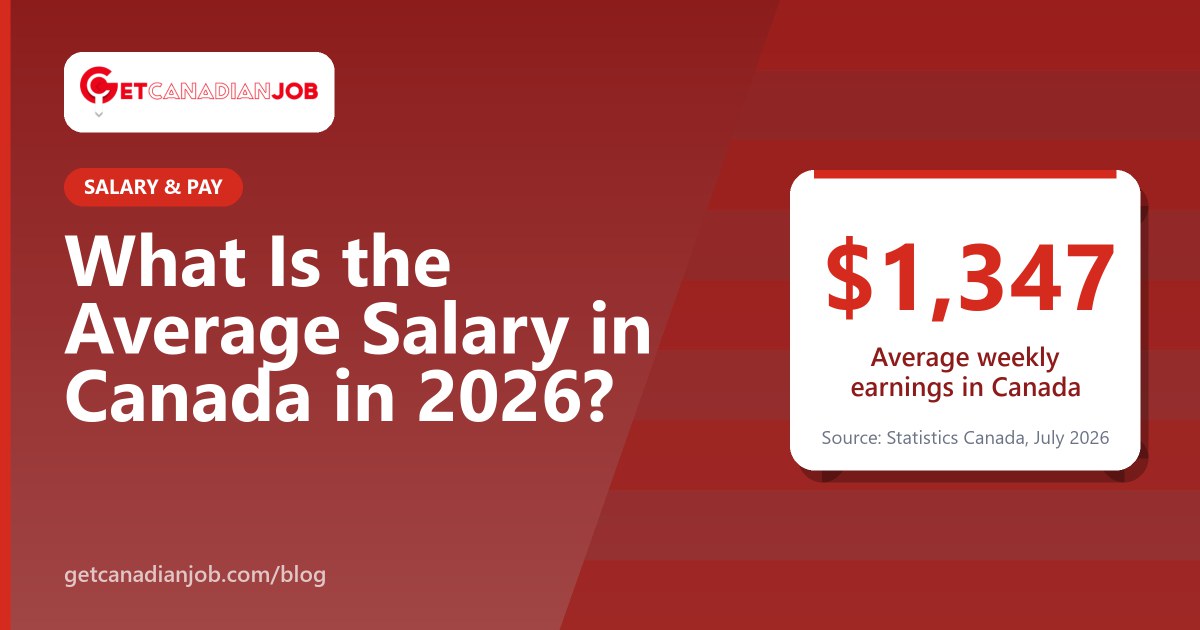
Table of contents
- What is the average salary in Canada in 2026?
- What does $70,000 a year look like per month, week and hour?
- How fast are wages rising in Canada in 2026?
- What is the minimum wage in each province in 2026?
- Why do salaries vary so much across Canada?
- Is my salary good for Canada?
- How can I earn more than the average?
- Sources
Last reviewed: October 17, 2026
Short answer: the average salary in Canada is about $70,000 a year in 2026. Statistics Canada's payroll survey put average weekly earnings at $1,347 in July 2026, up 3.2% from a year earlier, based on an average of 33.4 paid hours a week. That figure includes part-time workers, so full-time employees typically earn more. What counts as a good salary depends heavily on your province, industry and city.
Here's how to read Canada's salary numbers, how fast pay is rising, and where your own pay sits.
Key takeaways
- Average weekly earnings were $1,347 in July 2026, about $70,000 a year (Statistics Canada).
- Earnings rose 3.2% year over year; finance and insurance led with gains of 9.9%.
- Hourly wages for permanent employees grew 2.3% year over year in September 2026 (Labour Force Survey).
- Minimum wages range from $15.00 an hour in Alberta to $20.17 in Nunavut. The federal rate is $18.15.
- Canada's unemployment rate was 6.5% in September 2026, which is keeping a lid on raises.
What is the average salary in Canada in 2026?
The most widely quoted figure comes from Statistics Canada's Survey of Employment, Payrolls and Hours (SEPH), which uses payroll data from employers. In July 2026, average weekly earnings for non-farm payroll employees were $1,347, up 3.2% from July 2025.
Multiply by 52 weeks and you get about $70,044 a year. Keep in mind that this is an average across all employees, including part-time workers, so a typical full-time salary is somewhat higher. It's also a mean, which gets pulled up by high earners in fields such as finance, mining and tech.
What does $70,000 a year look like per month, week and hour?
| Period | Average gross earnings |
|---|---|
| Year | about $70,044 |
| Month | about $5,837 |
| Week | $1,347 |
| Hour (at 33.4 hours a week) | about $40.33 |
Based on Statistics Canada SEPH average weekly earnings, July 2026. Before income tax, Canada Pension Plan (or Quebec Pension Plan) contributions and Employment Insurance premiums.
Your take-home pay depends on your province, because each province sets its own income tax rates on top of federal tax. Payroll deductions also include CPP contributions and EI premiums: the employee EI rate in 2026 is $1.63 per $100 of insurable earnings ($1.30 in Quebec). The Canada Revenue Agency's payroll deductions online calculator gives an exact figure for your province.
How fast are wages rising in Canada in 2026?
More slowly than during the inflation spike of 2022–23, but still ahead of prices for most workers:
- Average weekly earnings rose 3.2% in the year to July 2026 (SEPH).
- Average hourly wages for permanent employees grew 2.3% in the year to September 2026 (Labour Force Survey).
- The biggest gains came in finance and insurance (+9.9%), management of companies (+9.4%), administrative and support services (+8.5%) and arts, entertainment and recreation (+7.4%).
With unemployment at 6.5% in September 2026 and employment down 68,000 that month, employers face less pressure to offer big raises. Switching jobs is still one of the most reliable ways to get a meaningful pay increase.
What is the minimum wage in each province in 2026?
| Province or territory | General minimum wage | Since |
|---|---|---|
| Nunavut | $20.17 | September 1, 2026 |
| Yukon | $18.51 | April 1, 2026 |
| British Columbia | $18.25 | June 1, 2026 |
| Federal (federally regulated industries) | $18.15 | April 1, 2026 |
| Ontario | $17.95 | October 1, 2026 |
| Prince Edward Island | $17.30 | October 1, 2026 |
| Northwest Territories | $17.20 | September 1, 2026 |
| Nova Scotia | $17.00 | October 1, 2026 |
| Quebec | $16.60 | May 1, 2026 |
| Manitoba | $16.40 | October 1, 2026 |
| Newfoundland and Labrador | $16.35 | April 1, 2026 |
| New Brunswick | $15.90 | April 1, 2026 |
| Saskatchewan | $15.70 | October 1, 2026 |
| Alberta | $15.00 | October 1, 2018 |
Rates as of October 2026. Some provinces have different rates for students, liquor servers or specific industries; check your provincial employment standards office for details.
At Ontario's $17.95, a full-time worker on 40 hours a week earns about $37,336 a year before deductions, roughly half the national average.
Why do salaries vary so much across Canada?
- Province and city. Alberta's energy sector, Toronto's finance industry and Vancouver's tech sector push wages up, but so do living costs, especially housing.
- Industry. Mining, oil and gas, utilities, finance and tech pay the most; accommodation and food services, retail and personal care pay the least.
- Occupation and experience. Managers, engineers, health professionals and skilled tradespeople with a Red Seal certification earn well above average.
- Union coverage. Unionized workers, especially in the public sector, tend to earn more and have better benefits.
Is my salary good for Canada?
As a rough guide for a full-time job in 2026:
- Under $40,000: near minimum wage in most provinces.
- $50,000 to $65,000: a common range for many skilled and office roles.
- Around $70,000: in line with the national average.
- $100,000 or more: comfortably high-earning in most of Canada, though it stretches less far in Toronto or Vancouver.
The most useful comparison is what employers are paying for your job, in your city, right now. Several provinces, including British Columbia and Ontario, now require employers to include pay ranges in job postings, which makes this much easier. Compare current postings for jobs in Toronto, jobs in Vancouver, or search jobs across Canada.
How can I earn more than the average?
- Benchmark your pay against current postings before your next review.
- Ask for a raise with evidence: market rates, new responsibilities and measurable results.
- Get certified. Red Seal trades, CPA, PMP and similar credentials carry clear pay premiums.
- Build AI skills. See how to AI-proof your career.
- Consider changing employers. It's usually the fastest route to a bigger raise.
Sources
- Statistics Canada, Survey of Employment, Payrolls and Hours, July 2026
- Statistics Canada, Labour Force Survey, September 2026
- Employment and Social Development Canada, 2026 Employment Insurance premium rates
- Provincial and territorial employment standards, minimum wage rates as of October 2026