Express Entry 2026: How to Get a Job and Permanent Residence in Canada
Express Entry is changing on November 3, 2026: qualifying job offers in high-wage occupations will earn CRS points again, without needing an LMIA. Here is how Express Entry works in 2026, the new draw categories, typical CRS scores and how to improve your chances.
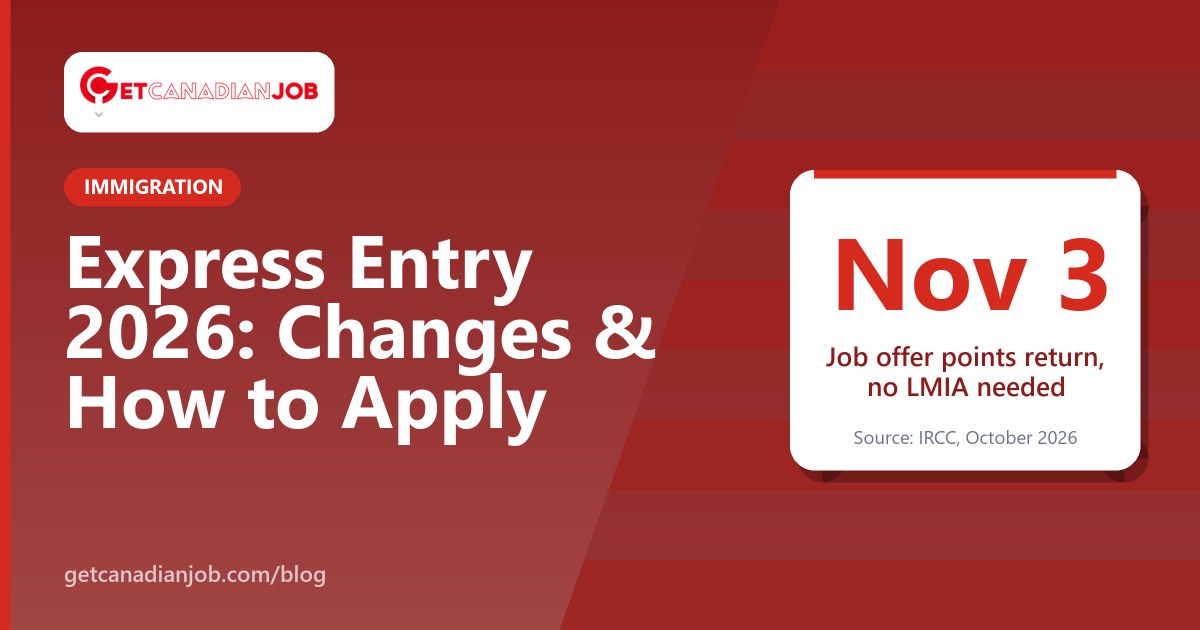
Table of contents
- What is Express Entry?
- What's changing on November 3, 2026?
- What are the Express Entry categories in 2026?
- What CRS score do you need in 2026?
- How do you apply through Express Entry? Step by step
- How does a Canadian job offer help?
- Is it getting harder to immigrate to Canada?
- Watch out for immigration scams
- Sources
Last reviewed: October 17, 2026. Immigration rules change often; always check Canada.ca before applying.
Short answer: Express Entry is Canada's main online system for skilled workers who want permanent residence. You create a profile, get a Comprehensive Ranking System (CRS) score, and wait for an invitation to apply. Canada plans to admit 380,000 permanent residents a year from 2026 to 2028, including about 109,000 through Express Entry in 2026. The big news: from November 3, 2026, candidates with Canadian work experience or a qualifying job offer in a high-wage occupation will get extra points, and those job offers will no longer need an LMIA.
Here's how the system works now, what's changing, and how a Canadian job offer can help your application.
Key takeaways
- Canada's target is 380,000 new permanent residents a year for 2026–2028, with about 109,000 through Express Entry in 2026.
- From November 3, 2026, qualifying job offers in high-wage occupations earn CRS points again, with no LMIA required (IRCC, October 16, 2026).
- "High-wage" means a median wage at least 1.3 times the overall Canadian median, including many jobs in health care, trades, engineering, tech and education.
- Four new 2026 draw categories target doctors, researchers and senior managers, transport workers and military recruits.
- New temporary resident arrivals are being cut to 385,000 in 2026.
What is Express Entry?
Express Entry is the online system Immigration, Refugees and Citizenship Canada (IRCC) uses to manage applications for three federal economic immigration programs:
- Federal Skilled Worker Program: for skilled workers with foreign work experience.
- Canadian Experience Class: for people with at least one year of skilled work experience in Canada.
- Federal Skilled Trades Program: for qualified tradespeople.
Provinces can also nominate candidates from the Express Entry pool through their Provincial Nominee Programs (PNPs), and a provincial nomination adds 600 CRS points, which practically guarantees an invitation.
What's changing on November 3, 2026?
On October 16, 2026, IRCC announced a major update (Canada.ca):
- New CRS points for candidates with eligible Canadian work experience, or a qualifying job offer in a high-wage occupation.
- No LMIA needed. A Labour Market Impact Assessment will no longer be required for a qualifying job offer to earn these points, or to meet the job offer requirements of the Federal Skilled Worker and Federal Skilled Trades programs.
- High-wage occupations are those whose median wage is at least 1.3 times the overall Canadian median. IRCC will publish the list, based on three years of Job Bank, Labour Force Survey and Census data.
- Scores will be recalculated for everyone in the pool. Invitation rounds may pause for up to two weeks while that happens.
If you have a job offer, update your Express Entry profile before November 3, 2026 so it counts when scores are recalculated.
In plain terms: a Canadian employer's job offer matters again, and it's much easier for employers to make one, because they no longer have to go through the LMIA process first.
What are the Express Entry categories in 2026?
Besides general draws, IRCC runs category-based draws that invite candidates with specific skills, often at lower CRS scores. The 2026 categories, announced on February 18, 2026, are:
| Category | Status in 2026 | Examples |
|---|---|---|
| Physicians with Canadian work experience | New | Family doctors, specialists |
| Researchers and senior managers with Canadian work experience | New | Research scientists, senior executives |
| Transport occupations | New | Pilots, aircraft mechanics, inspectors |
| Highly skilled military recruits | New | Military doctors, nurses and pilots recruited by the Canadian Armed Forces |
| Health care and social services | Continuing | Nurse practitioners, dentists, pharmacists, psychologists |
| Trades | Continuing | Carpenters, plumbers, machinists, electricians |
| French-language proficiency | Continuing | Candidates with strong French skills in any eligible occupation |
Source: IRCC, February 18, 2026.
What CRS score do you need in 2026?
There's no fixed pass mark. Each draw has its own cutoff, depending on how many people are invited and who's in the pool. Between January and early October 2026, reported cutoffs included:
- Canadian Experience Class: roughly 507 to 523
- Health care and social services: roughly 467 to 475
- Trades: about 476 to 477
- French-language proficiency: roughly 382 to 420
- Provincial Nominee Program draws: roughly 697 to 805 (including the 600 nomination points)
The takeaway: strong French, Canadian work experience, a provincial nomination, or a job in a priority category can matter more than your general score. Expect these numbers to move after the November 3 recalculation.
How do you apply through Express Entry? Step by step
- Check your eligibility for at least one of the three programs using IRCC's online tool.
- Take an approved language test: CELPIP, IELTS General Training or PTE Core for English; TEF Canada or TCF Canada for French.
- Get an Educational Credential Assessment (ECA) if you studied outside Canada.
- Create your Express Entry profile online. You'll get a CRS score and enter the pool.
- Improve your score while you wait: better language results, a second language, a provincial nomination or a qualifying job offer.
- If invited, apply within 60 days with your full documents, medical exam and police certificates. IRCC aims to process most complete applications in about six months.
How does a Canadian job offer help?
From November 3, 2026, a qualifying job offer in a high-wage occupation earns extra CRS points without an LMIA, making Canadian employers a much more direct route to permanent residence. Even without the points, Canadian work experience counts strongly through the Canadian Experience Class.
Employers in health care, the skilled trades, engineering and technology are among the most likely to qualify. You can search jobs in Canada on GetCanadianJob, including engineering jobs and IT and software jobs, and prepare a Canadian-style resume before you apply.
Is it getting harder to immigrate to Canada?
In some ways, yes. The 2026–2028 Immigration Levels Plan holds permanent residence steady at 380,000 a year, but cuts new temporary resident arrivals to 385,000 in 2026, as the government aims to bring temporary residents below 5% of the population by the end of 2027. Fewer study and work permits means more competition for the permanent residence spots that remain, and a stronger focus on candidates who already have Canadian experience or skills in short supply.
Watch out for immigration scams
Creating an Express Entry profile is free. No one can guarantee you an invitation or sell you a job offer with Express Entry points. Only use authorized representatives: licensed immigration consultants (registered with the College of Immigration and Citizenship Consultants) or lawyers. Report suspected fraud to the Canadian Anti-Fraud Centre.
Sources
- IRCC, Canada refocusing Express Entry on top talent that drives economic growth, October 16, 2026
- IRCC, Canada prioritizes top talent in 2026 Express Entry categories, February 18, 2026
- IRCC, Supplementary information for the 2026–2028 Immigration Levels Plan
- IRCC Express Entry rounds of invitations, January to October 2026
This guide is general information, not legal advice. For your own situation, consult a licensed immigration consultant or lawyer.