Graphic Design Jobs in Canada: Toronto Salaries, Skills and Portfolio Tips (2026)
Graphic designers in Canada work for agencies, broadcasters, banks, retailers, colleges and governments, and Toronto is the biggest market. Here is what graphic design jobs pay by city, the skills employers want in 2026, and how to build a portfolio that gets interviews.
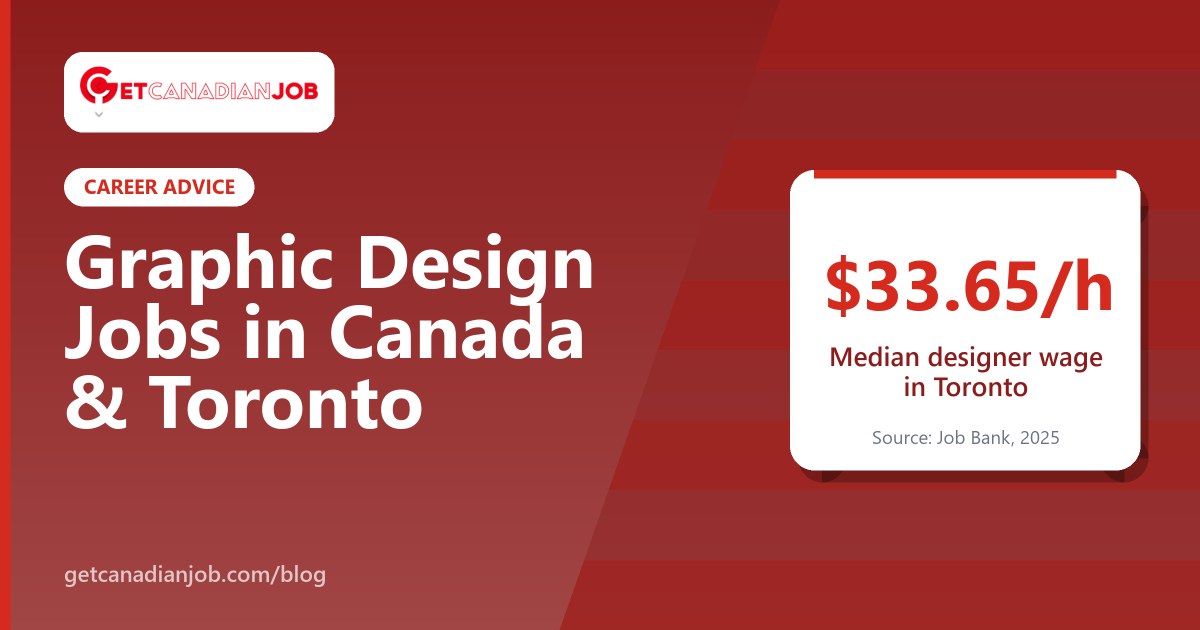
Table of contents
Last reviewed: October 26, 2026
Short answer: graphic designers in Canada earn a median of $31.25 an hour, about $61,000 a year full-time, according to Job Bank's 2025 wage data. The range runs from $20.00 at entry level to $52.88 for experienced designers. Toronto and Ottawa pay a median of $33.65, and British Columbia $35.00. Most employers hire on the strength of your portfolio, alongside a college diploma or degree in graphic design and solid skills in Adobe Creative Cloud and Figma.
Key takeaways
- The national median for graphic designers and illustrators is $31.25 an hour (Job Bank, 2025 release).
- Toronto is the biggest market; "graphic design jobs Toronto" is one of the most-searched terms on GetCanadianJob.
- Show 6 to 10 strong projects, each with the brief, your process and the result.
- Digital, motion and accessibility skills now matter as much as print.
- In Ontario, the RGD (Registered Graphic Designer) designation is a recognized professional credential.
How much do graphic designers make in Canada?
Job Bank's 2025 wages for graphic designers and illustrators (NOC 52120):
| Area | Low | Median | High | Median per year (approx.) |
|---|---|---|---|---|
| Canada | $20.00 | $31.25 | $52.88 | $61,000 |
| Toronto | $21.00 | $33.65 | $53.37 | $66,000 |
| Ottawa | $22.00 | $33.65 | $60.10 | $66,000 |
| Calgary | $20.00 | $30.00 | $43.27 | $59,000 |
| Edmonton | $20.81 | $27.41 | $44.97 | $53,000 |
| British Columbia | $24.04 | $35.00 | $57.69 | $68,000 |
Related design jobs often pay more. Job Bank's national medians are $33.65 an hour for web designers and $34.96 for graphic arts technicians, and UX and product design roles in tech companies are higher still.
Where are the graphic design jobs?
Graphic designers work in four main settings:
- In-house teams at banks, telecoms, broadcasters, retailers, colleges, hospitals and governments. This is the largest group.
- Agencies: branding, advertising, packaging and digital studios, concentrated in Toronto, Montreal and Vancouver.
- Media and entertainment: broadcasters, publishers, music and live events. Toronto's music and entertainment industry is a popular search on GetCanadianJob.
- Freelance: usually after a few years of experience and with a client network. Remember to register for GST/HST once your revenue passes $30,000.
Graphic design jobs in Toronto
Toronto has Canada's largest concentration of agencies, media companies and corporate head offices. In-house design teams at banks, telecoms and retailers hire steadily, as do colleges, universities and the public sector. Browse graphic design jobs in Toronto.
Elsewhere in Canada
Montreal has a large agency, gaming and digital media scene, where French is usually needed. Vancouver has film, gaming and tech. Ottawa's design jobs are often in government and need bilingualism. Calgary and Edmonton have in-house roles in energy, construction and retail. See all graphic design jobs in Canada.
What skills do employers want?
- Adobe Creative Cloud: Illustrator, Photoshop and InDesign are still the baseline in most postings.
- Figma for web, app and social design.
- Motion basics: After Effects or similar, for social video and digital ads.
- Typography, layout and brand systems: applying a brand consistently across many formats.
- Accessibility: colour contrast, readable type and accessible PDFs. This is especially important for public sector work, since Ontario's accessibility law (AODA) sets standards for many organizations.
- Bilingual layouts: setting English and French versions, which is common for national and federal clients.
- Print production: bleeds, colour profiles and working with printers.
- AI image tools, used responsibly: employers want designers who understand licensing and brand control.
Do you need a degree?
Most designers have a college diploma or advanced diploma in graphic design. Programs at Sheridan, Humber and George Brown are well known in the Toronto area, and many designers have a university degree such as a Bachelor of Design. Even so, employers hire on the portfolio. A self-taught designer with strong work can compete.
In Ontario, the Association of Registered Graphic Designers (RGD) grants the RGD designation, a recognized credential for experienced designers. It isn't required to work, but some employers and clients value it, and RGD runs job boards, events and salary research.
How to build a portfolio that gets interviews
- Quality over quantity: 6 to 10 strong projects, not 30 average ones.
- Tell the story: for each project, give the brief, audience, idea and result. "Redesigned a clinic's intake form; missed fields dropped by a third" beats a pretty image with no context.
- Match the job: lead with brand work for agencies, information-heavy and accessible work for public sector roles, and campaign and social work for in-house marketing teams.
- Include real-world work: non-profit, student, freelance and volunteer projects all show you can work with a real client.
- Make it easy to open: a simple website or a PDF under 10 MB, linked at the top of your resume.
Applying for graphic design jobs
- Tailor your resume to each posting, mirroring the software and skills it lists. Our guide to the Canadian resume format explains how.
- Write a short, specific cover note naming a project in your portfolio that fits the role.
- Expect a design test for some roles. It's fine to ask how long it should take and how it will be used.
- Look at adjacent roles: production artist, digital designer, marketing designer and web designer all use the same skills.
When you're ready, browse graphic design jobs in Toronto and art and creative jobs, then create a free GetCanadianJob account to get new design jobs by email.
Sources
- Job Bank (Government of Canada), wages for graphic designers and illustrators (NOC 52120), web designers (NOC 21233) and graphic arts technicians (NOC 52111), 2025 release
- Association of Registered Graphic Designers (RGD), the RGD designation
- Canada Revenue Agency, GST/HST small supplier threshold
- Accessibility for Ontarians with Disabilities Act (AODA)