911 Dispatcher Jobs in Canada: Requirements, Testing and Pay in 2026
911 dispatchers answer emergency calls and send police, fire and paramedics where they are needed. Here is who hires them in Canada, the requirements and tests you will face, what training looks like, and what the job pays in Ontario, Alberta and British Columbia in 2026.
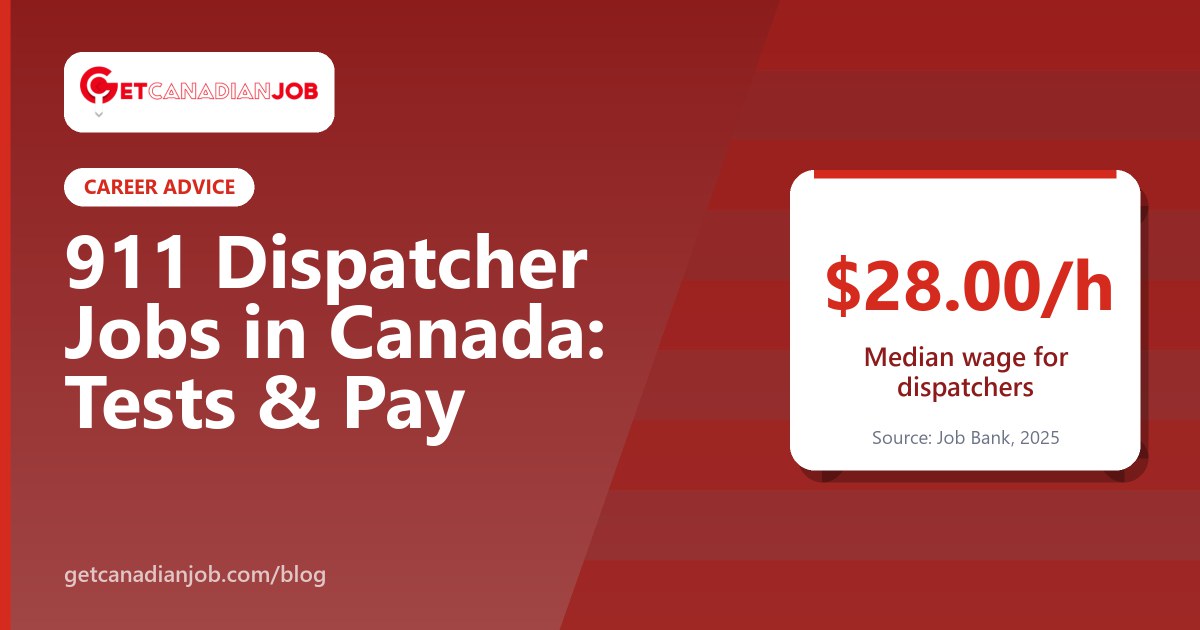
Table of contents
- Who hires 911 dispatchers in Canada?
- What are the requirements to become a 911 dispatcher?
- What is the 911 dispatcher hiring process like?
- How much do 911 dispatchers make in Canada?
- What is the job actually like?
- What is NG911 and why does it matter for jobs?
- How to stand out when you apply
- Sources
Last reviewed: October 26, 2026
Short answer: to get a 911 dispatcher job in Canada, you usually need a high school diploma, CPR and first aid, a typing speed of around 35 to 40 words per minute, and a pass on the CritiCall computer test, which checks multitasking, call-taking and map reading. Employers train you after hiring. Job Bank puts the median wage for dispatchers at $28.00 an hour across Canada, rising to about $30.00 in Alberta and $31.35 in British Columbia, and police services in big cities often pay more.
There's no single provincial licence for 911 work. Each police service, paramedic service, fire department or regional communications centre runs its own hiring, so the details below vary slightly by employer.
Key takeaways
- Most 911 jobs need Grade 12, CPR and first aid, a typing test and the CritiCall test.
- Toronto Paramedic Services asks for 35 words per minute at 90% accuracy and a CritiCall score of at least 70%.
- The national median wage for dispatchers is $28.00 an hour (Job Bank, 2025 release).
- Expect rotating 12-hour shifts, including nights, weekends and holidays.
- Canada is moving to Next Generation 911 (NG911). The CRTC's deadline to switch off the old networks is March 31, 2027.
Who hires 911 dispatchers in Canada?
"911 dispatcher" covers a few different jobs, and the titles change from employer to employer:
- Emergency call takers answer 911 calls, find out what's happening and where, and route the call to the right service.
- Police communicators or dispatchers work for services such as Toronto Police, the OPP and regional police forces. They dispatch officers and track every unit on the radio.
- Emergency medical dispatchers (EMDs) work for paramedic services. They triage medical calls and coach callers through CPR until help arrives.
- Fire dispatchers work for municipal fire services or regional dispatch centres.
Searches for "911 dispatcher jobs Ontario" are among the most popular on GetCanadianJob. Ontario has dozens of police and paramedic communication centres, so openings come up all year. You'll find current postings under public sector jobs in Canada.
What are the requirements to become a 911 dispatcher?
Requirements differ by employer, but most Canadian services ask for:
- Education: Grade 12 or an approved equivalent. A college diploma in police foundations or emergency communications helps, but it's rarely required.
- Certifications: current CPR and Standard First Aid. Toronto Paramedic Services asks for CPR Level C.
- Typing: usually 35 to 40 words per minute with high accuracy. Toronto Paramedic Services requires 35 words per minute at 90% accuracy.
- CritiCall: a computer-based test that simulates dispatch work. It checks multitasking, prioritizing, data entry, listening and map reading, and takes up to about two hours.
- Background checks: a police record check, often a vulnerable sector check, and references.
- Hearing and vision: many services test both, because you'll be listening to radio traffic while reading several screens.
- Language: French is required for bilingual positions, for example in Ottawa and for some federal and Quebec services.
What is the 911 dispatcher hiring process like?
Here's how Toronto Paramedic Services describes its emergency medical dispatcher process, which is typical:
- Stage 1: application and an online typing test.
- Stage 2: a written exam (including knowledge of Toronto's major streets) and the CritiCall test.
- Stage 3: a one-hour, in-person interview in Multiple Mini Interview format.
- Stage 4: reference checks and a conditional offer.
- Training: a three-day Medical Priority Dispatch System (MPDS) course, then an internal dispatcher training program with classroom, hands-on call-handling and online modules.
Police services add their own steps, often a longer background investigation. The whole process can take several months, so apply to more than one centre at a time.
How much do 911 dispatchers make in Canada?
Job Bank's 2025 wage data for dispatchers (NOC 14404) gives these hourly medians:
| Area | Low | Median | High |
|---|---|---|---|
| Canada | $20.00 | $28.00 | $41.76 |
| Ontario | $19.35 | $26.75 | $43.18 |
| Toronto | $19.52 | $28.07 | $44.21 |
| Ottawa | $21.30 | $30.63 | $44.14 |
| Calgary and Edmonton | $21.00 | $30.00 | $46.00 |
| British Columbia | $21.00 | $31.35 | $40.87 |
That occupation group includes all kinds of dispatchers, from taxi and courier dispatch to emergency services. Unionized emergency roles sit toward the top of the range: Toronto Police lists a starting salary of about $83,500 for its communications operators in 2026. Most public employers also add shift premiums, overtime, a defined benefit pension and health benefits.
What is the job actually like?
Dispatching suits calm, organized people who can type while they listen. On a typical shift you might:
- answer 911 and non-emergency calls, often from people in crisis;
- enter details into a computer-aided dispatch (CAD) system while still talking to the caller;
- dispatch and track police, fire or paramedic units over the radio;
- give pre-arrival instructions such as CPR or bleeding control;
- check licence plates, addresses and warrants in police databases.
The hard parts are the shift work and the emotional load. Calls involving children, violence or suicide stay with people. Good employers offer peer support, debriefing and employee assistance programs. Ask about them at the interview.
What is NG911 and why does it matter for jobs?
Canada is replacing its old 911 networks with Next Generation 911 (NG911). NG911 is an internet-based system that will eventually support text messages, photos and video from callers. The CRTC pushed the deadline for switching off the legacy networks to March 31, 2027. In practice, that means new software, more training and, for experienced dispatchers, extra roles in quality assurance and systems support.
How to stand out when you apply
- Practise typing until you're comfortably above the minimum, because you'll be tested twice at some services.
- Take a CritiCall practice test. Many applicants fail on the multitasking sections, not the typing.
- Learn local geography. Know the major streets, highways and landmarks of the area you'll cover.
- Show calm under pressure on your resume. Experience in call centres, healthcare, security or customer service all counts. Our guide to the Canadian resume format explains how to present it.
- Get your CPR and first aid before you apply, so you meet the requirement on day one.
Ready to apply? Browse public sector jobs in Toronto and jobs in Ontario, then create a free GetCanadianJob account to get new dispatcher jobs by email.
Sources
- Job Bank (Government of Canada), wages for dispatchers (NOC 14404), 2025 release
- City of Toronto, Toronto Paramedic Services emergency medical dispatcher opportunities
- Toronto Police Service, communications operator careers page (2026)
- CRTC, decision extending the NG911 transition deadline to March 31, 2027 (February 2025)